Abstract
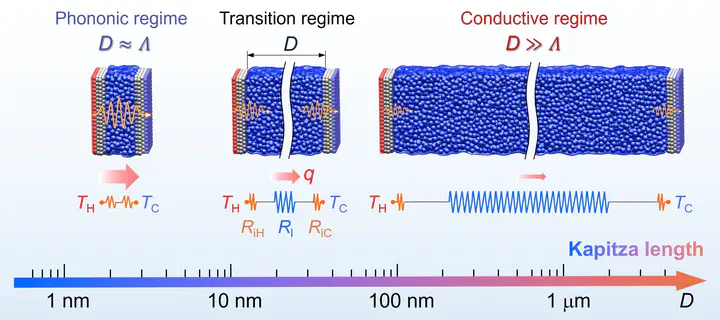
Understanding thermal energy transport at solid–liquid interfaces is critical for enhancing the performance of nano- or microscale systems. Although extensive studies have addressed the interfacial thermal resistance, known as Kapitza length, its impact on interfacial heat transfer from nanoscale to microscale remains limited. This study explores the Kapitza length at hydrophilic and hydrophobic solid–liquid interfaces under constant heat flux or overall temperature difference using nonequilibrium molecular dynamics simulations. The findings reveal that Kapitza length remains nearly constant under constant heat flux, while it is comparable to the liquid film thickness under constant overall temperature differences in both nano- and microscale systems. Notably, a giant Kapitza length of 1382 nm was found at a hydrophobic solid–liquid interface with a 1082 nm-thick liquid film. Upon comparing Kapitza length obtained from simulation with experimental results, three primary regimes of solid–liquid interfacial heat transfer are identified as phononic, transition, and conductive regimes. These insights highlight the substantial effect of Kapitza length on solid–liquid interfacial heat transfer from nano- to microscales, offering potential avenues for advanced thermal management in nano- or microscale systems.

Wentao Chen
Associate Professor
My research interests include extreme near-field heat transfer, thermal transport at the solid-solid and solid-liquid interface, and molecular dynamics simulation.