Abstract
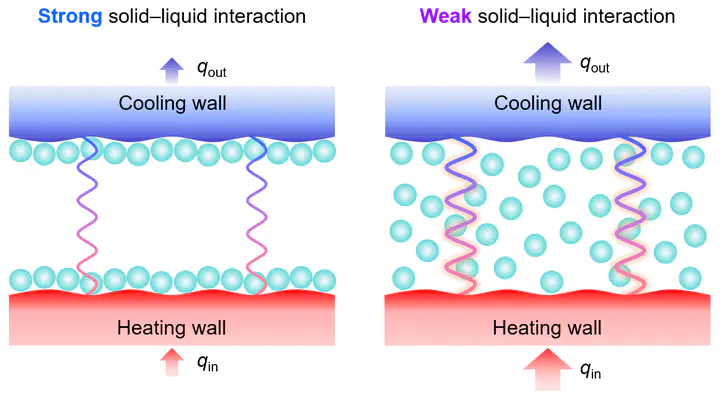
Phonon heat transfer across a nanogap has been attributed to adsorbed liquid layers through quasi-Casimir coupling enabled by strong solid–liquid interactions. However, whether phonons can effectively transmit across a nanogap under weak solid–liquid interactions remains unclear. In this study, nonequilibrium molecular dynamics simulations are conducted to investigate the influence of solid–liquid interaction strength on thermal transport across nanogaps with varying gap distances. The results show that both heat flux and thermal gap conductance increase with increasing work of adhesion in the absence of liquid separation, whereas they decrease in the presence of liquid separation. Surprisingly, weak solid–liquid interactions are found to enhance heat transfer across a nanogap between planar solid walls. This enhancement is attributed to reduced phonon mismatch between interfacial solid layers, facilitated by liquid atomic collisions. These findings reveal a nonconventional mechanism for manipulating nanoscale thermal transport and provide guidance for the design of advanced thermal management devices.

Wentao Chen
Associate Professor
My research interests include extreme near-field heat transfer, thermal transport at the solid-solid and solid-liquid interface, and molecular dynamics simulation.