Elucidating phonon heat transfer and interfacial thermal resistance at micro-nanoscale
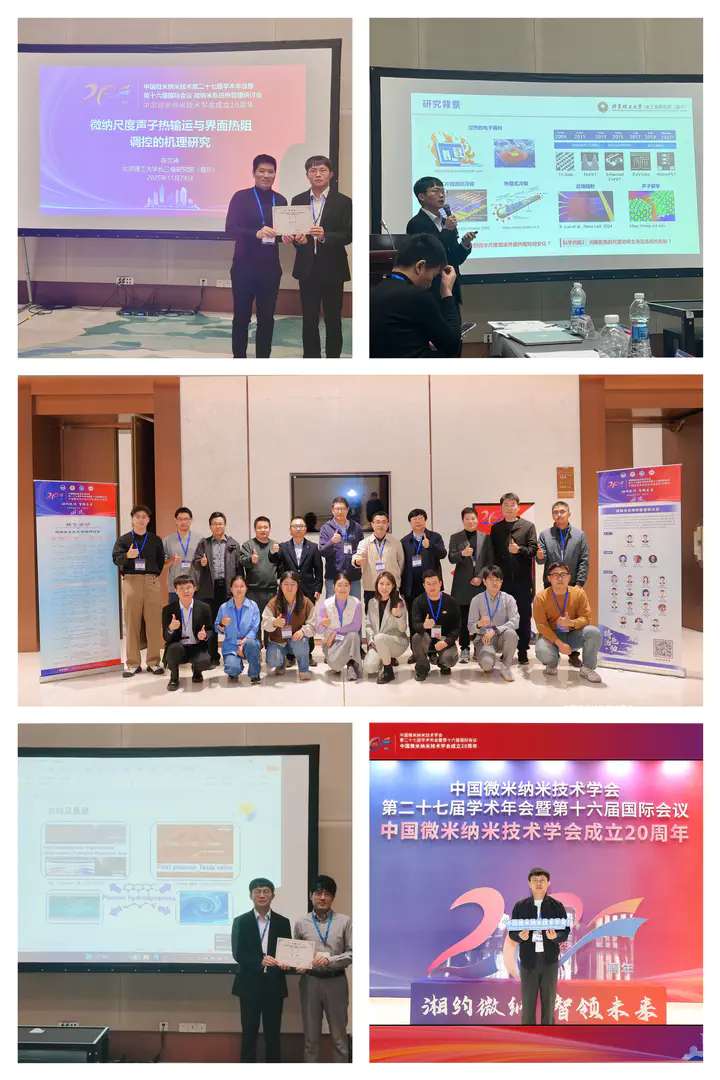
Abstract
With the ongoing miniaturization and pursuit of higher performance in electronic devices, thermal management within micro/nano-structured components such as chips has become a critical challenge. Classical heat transfer theories often fail at these scales, where microscopic mechanisms including quantum and interface effects begin to dominate. While conventional understanding holds that heat transfer in vacuum is contributed by photons rather than phonons, recent studies have revealed that phonons can mediate heat transfer across nanoscale vacuum gaps via quantum fluctuations of electromagnetic fields. Specifically, between two bodies separated by a nanoscale vacuum gap, phonons can transfer heat more effectively than photons. In this work, we propose a novel heat transfer mechanism: even in the absence of electromagnetic fields, phonon tunneling can be enabled through quasi-Casimir coupling across nanogaps. We demonstrate that thermal resonance between adsorbed liquid layers or solid interfacial layers can significantly enhance phonon heat transfer across the nanogap. Furthermore, by modifying the surface termination of SiC and applying external electric fields, we show that quasi-Casimir coupling can induce interfacial thermal resonance under identical surface terminations. Combined with electric field modulation, this allows dynamic tuning of atomic vibrational displacements at the interface, enabling active optimization of phonon tunneling. Additionally, the continued miniaturization of micro/nano-electronic devices has heightened interest in heat transport across solid-liquid interfaces. It is noteworthy that when the characteristic length of the system approaches micro/nano dimensions, non-classical boundary conditions play a major role. Upon comparing Kapitza length obtained from simulation with experimental results, three primary regimes of solid–liquid interfacial heat transfer are identified: phononic, transition, and conductive regimes. This fundamental investigation into micro/nanoscale heat transfer mechanisms provides essential insights for the design of efficient thermal management systems, performance optimization of microelectronic devices, and the development of novel energy conversion technologies.

Wentao Chen
Associate Professor
My research interests include extreme near-field heat transfer, thermal transport at the solid-solid and solid-liquid interface, and molecular dynamics simulation.