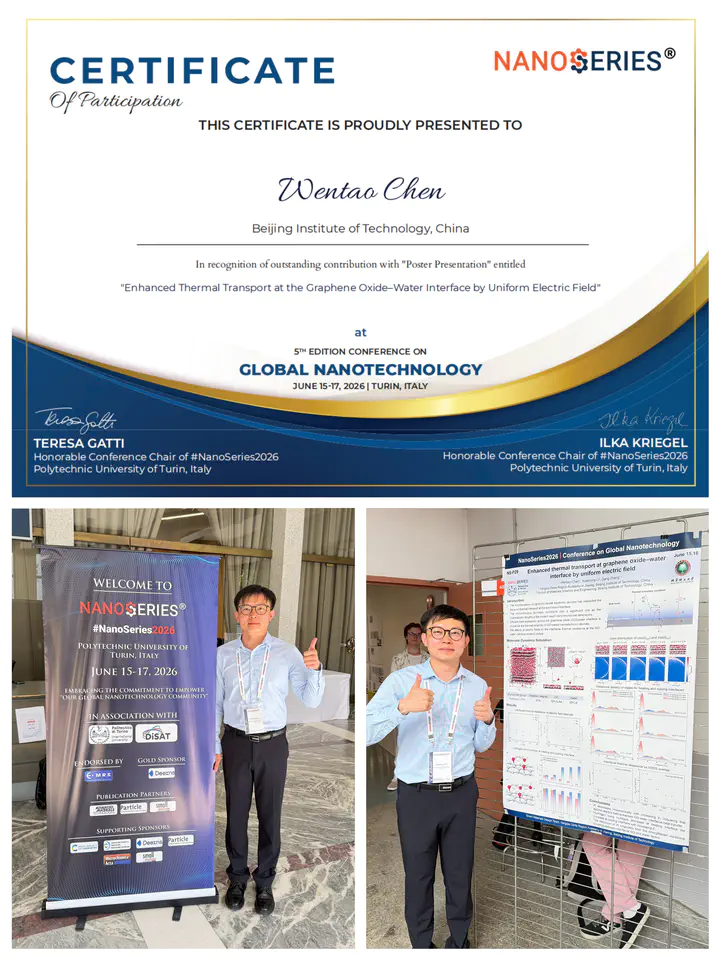
Enhanced thermal transport at graphene oxide–water interface by uniform electric field
Abstract
Efficient heat dissipation across the graphene oxide (GO)–water interface is crucial for the thermal reliability of graphene- and GO-based nanoelectronic devices. Previous study have shown that the oxidation degree of graphene can regulate interfacial heat transfer, and a linear correlation between oxidation degree and interfacial thermal resistance has been identified at low-to-moderate oxidation levels. However, the effects of electric field on the interfacial thermal resistance at the GO–water interface remains unclear. In this study, non-equilibrium molecular dynamics (NEMD) simulations were performed in LAMMPS to investigate electric field controlled interfacial thermal transport at the GO–water interface.

Wentao Chen
Associate Professor
My research interests include extreme near-field heat transfer, thermal transport at the solid-solid and solid-liquid interface, and molecular dynamics simulation.